The Middle East is experiencing one of the most ambitious infrastructure construction periods in modern history. Massive government-funded projects across Saudi Arabia, the UAE, Qatar, and Egypt are creating unprecedented demand for construction equipment — and driving significant growth in the Middle East excavator hydraulic seal market.
The Scale of Middle East Infrastructure Investment
Saudi Arabia’s NEOM and Vision 2030 Projects
Saudi Arabia’s commitment to economic diversification under Vision 2030 has created the world’s largest construction program. Key projects driving excavator demand:
- NEOM: The $500 billion new city project requires an estimated 50,000+ construction machines, including thousands of excavators
- Red Sea Project: Luxury tourism development spanning 28,000 square kilometers with 90+ islands
- The Line: Linear city extending 170 kilometers along the Red Sea coast
- Qiddiya Entertainment City: Large-scale entertainment and sports complex in Riyadh
- ROSHN developments: Saudi Arabia’s national housing development program
UAE Continued Expansion
The UAE maintains strong construction activity:
- Dubai’s continued infrastructure upgrades and World Expo legacy projects
- Abu Dhabi’s infrastructure diversification
- Northern Emirates development programs
- Major road and rail projects connecting the federation
Qatar and Bahrain
Post-FIFA infrastructure development continues in Qatar, while Bahrain invests in industrial and commercial construction to support economic growth.
Excavator Fleet Composition in the Middle East
The Middle East excavator market is characterized by:
- Brand diversity: CAT, Komatsu, Volvo, Hitachi, and JCB all have strong market presence
- Large machine preference: Middle East projects favor large and ultra-large excavators for mass excavation
- Heavy-duty operation: Machines operate at high utilization rates in demanding conditions
- Extreme climate requirements: Seals must perform reliably in temperatures exceeding 45C
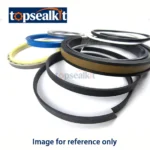
Premium excavator seal kits with high-temperature specifications are essential for Middle East applications.
Challenges Driving Seal Demand
Desert Conditions and Sand Contamination
Middle East desert environments create extreme sealing challenges:
- Fine silica dust: Penetrates equipment despite filtration, requiring robust wiper seals
- Temperature extremes: Daytime temperatures of 45-50C stress seal materials beyond standard specifications
- Thermal cycling: Large temperature swings between day and night accelerate seal aging
- Humidity variations: Coastal construction sites experience high humidity and salt air
These conditions require heavy-duty hydraulic cylinder seal kits with enhanced specifications for desert operation.
High Utilization Rates
Middle East construction projects typically operate equipment at 3,000-5,000 hours annually — significantly above global averages:
- Faster wear cycles: Seals degrade more rapidly at high utilization
- More frequent maintenance: Maintenance intervals compressed due to hours accumulation
- Increased contamination exposure: More operating hours means more exposure to abrasive materials
The Aftermarket Opportunity
The Middle East construction boom creates substantial aftermarket seal demand:
Replacement Cycle Acceleration
Heavy-duty operation accelerates replacement cycles:
- Standard seal replacement: Every 2,000-3,000 hours instead of standard 4,000-6,000
- Heavy-duty seal requirement: Premium products designed for harsh conditions
- Multiple cylinder coverage: Large excavators with 4-6 cylinders per machine
Spare Parts Logistics Challenges
Geographic logistics create unique aftermarket challenges:
- Remote project locations: Equipment often deployed far from urban parts suppliers
- Supply chain delays: Air freight costs and customs procedures add to delivery times
- Inventory requirements: Contractors must hold extensive parts stocks on-site
Online procurement of excavator seal kits with international shipping addresses this challenge.
Key Seal Requirements for Middle East Excavators
High-Temperature Performance
Seals must perform reliably in ambient temperatures of 45-50C:
- Material selection: Heat-stabilized PU compounds for rod seals
- FKM for critical applications: Viton/FKM seals for areas exposed to highest temperatures
- Thermal stability: Seals must maintain properties at continuous elevated temperatures
Contamination Resistance
Desert sand requires maximum contamination protection:
- Heavy-duty wiper seals: Multi-lip designs with metal reinforcement
- Enhanced rod seal geometries: Optimized for dusty environments
- PTFE piston seals: Chemical resistance for contaminated fluid conditions
Supply Chain Solutions
Effective supply chain strategies for Middle East excavator seal procurement:
- Strategic inventory positioning: Stock seals at regional hubs in Dubai, Jeddah, or Doha
- Express shipping programs: Priority delivery for urgent requirements
- Digital procurement platforms: Online ordering with real-time tracking and inventory visibility
- Technical support access: Remote assistance for seal selection and troubleshooting
Conclusion
The Middle East construction boom presents significant opportunities for excavator seal suppliers who can meet the region’s unique requirements: high-temperature performance, contamination resistance, and reliable supply chain logistics. Equipment operators in this region benefit from sourcing quality excavator seal kits designed for Middle East conditions.
The scale of investment — NEOM alone will require decades of construction activity — means this market will remain robust for years to come. Planning seal procurement strategies for this environment is essential for contractors seeking to minimize downtime and maximize equipment utilization.
Keywords: Middle East construction boom, Saudi Arabia excavator market, NEOM construction equipment, excavator seal demand Middle East, desert excavator maintenance