When servicing excavator hydraulic cylinders, understanding the difference between rod seals and piston seals is fundamental. These two seal types perform completely different functions, face different operating conditions, and fail in different ways. Confusing them leads to incorrect diagnosis, wrong parts orders, and failed repairs.
Rod Seals: Containing Pressure at the Cylinder Exit
The rod seal is installed in the cylinder gland — the end cap through which the piston rod exits the cylinder body. Its job is to prevent high-pressure hydraulic fluid from leaking out of the cylinder along the rod surface.
How Rod Seals Work
The rod seal creates a dynamic pressure seal against the moving piston rod. As the rod moves in and out, the seal lip maintains continuous contact with the rod surface, preventing fluid from escaping. This requires the seal to simultaneously:
- Maintain a pressure seal against hydraulic fluid at up to 350 bar
- Allow smooth rod movement without excessive friction
- Retain a thin lubricating film of hydraulic fluid on the rod surface
- Resist abrasion from the rod surface over thousands of cycles
Rod Seal Failure Symptoms
- External oil leak: Visible hydraulic oil around the rod at the cylinder gland
- Oil accumulation: Pooling of oil on the machine frame or ground beneath the cylinder
- Increased fluid consumption: Hydraulic reservoir level drops faster than normal
Rod Seal Materials
Polyurethane (PU) is the dominant material for excavator rod seals due to its excellent combination of abrasion resistance, pressure resistance, and dynamic sealing performance. Premium excavator seal kits use 90-95 Shore A PU for rod seals.
Piston Seals: Managing Pressure Inside the Cylinder
The piston seal is installed on the piston itself — the component that moves inside the cylinder bore. Its function is fundamentally different from the rod seal: it separates the two hydraulic pressure chambers on either side of the piston.
How Piston Seals Work
When hydraulic pressure is applied to one side of the piston, the piston seal prevents fluid from bypassing the piston to the other side. This pressure differential is what creates the force that extends or retracts the cylinder. Without an effective piston seal, fluid bypasses the piston and the cylinder loses force and speed.
Unlike rod seals, piston seals must seal in both directions — they must hold pressure whether the cylinder is extending or retracting.
Piston Seal Failure Symptoms
- Cylinder drift: The cylinder slowly moves under load when the control lever is in neutral
- Reduced force: The excavator cannot lift or dig with normal force
- Slow response: Cylinders respond sluggishly to control inputs
- No external leak: Piston seal failures are internal — no visible oil outside the cylinder
Piston Seal Materials
Piston seals use different materials than rod seals because they operate against the cylinder bore rather than a polished rod:
- PTFE (Teflon): Low friction, excellent chemical resistance, wide temperature range
- Filled PTFE: Carbon, glass, or bronze-filled PTFE for enhanced mechanical properties
- Polyurethane: Used in some designs for high-pressure applications
Key Differences at a Glance
- Location: Rod seal in gland (rod exit); piston seal on piston (inside bore)
- Function: Rod seal prevents external leakage; piston seal prevents internal bypass
- Failure symptom: Rod seal = visible external leak; piston seal = cylinder drift, no external leak
- Material: Rod seal typically PU; piston seal typically PTFE or filled PTFE
- Sealing direction: Rod seal seals in one direction; piston seal seals in both directions
Why Both Must Be Replaced Together
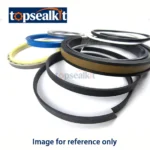
Complete hydraulic cylinder seal kits include both rod seals and piston seals for good reason. When you open a cylinder for service, both seal types have experienced the same operating hours and conditions. Replacing only the obviously failed seal while leaving the other in place typically results in the second seal failing within a few hundred hours — requiring another full cylinder teardown.
The CAT 308D CR SB Oil Seal Kit and all our complete seal kits include both rod seals and piston seals, along with all supporting components.
Conclusion
Rod seals and piston seals are fundamentally different components with different functions, materials, and failure modes. Understanding these differences helps you diagnose hydraulic problems accurately, order the correct parts, and perform effective repairs. Browse our complete range of excavator parts for seal kits covering all major brands and models.
Keywords: rod seal vs piston seal, hydraulic cylinder seals, excavator seal types, cylinder drift piston seal, rod seal leak, hydraulic seal function